
Across Western Canada, organizations are increasingly seeking practical pathways to reduce energy consumption, meet greenhouse gas (GHG) emission reduction targets, and renew aging building systems. At Prism Engineering, we’ve supported clients through this transition for years, completing numerous decarbonization projects across commercial, institutional, government, and recreational facilities.
Last October, Robert Greenwald, President of Prism Engineering, shared field‑tested insights at the 2025 Engineers and Geoscientists BC (EGBC) Annual Conference in Vancouver. They were drawn from our review of over 25 major projects, from recreation centres and airports to academic campuses and office towers. The findings reveal clear patterns in what drives success, where challenges typically emerge, and how organizations can confidently move toward low‑carbon operations.
Below are five practical lessons property managers, building owners, and operators can apply immediately.
Lesson 1 – Start with stakeholder engagement and clear visioning
Across nearly every project reviewed, effective early engagement proved to be one of the predictors of success. Operators, capital planners, sustainability staff, finance teams, and tenants each bring unique priorities.
Visioning workshops, which were used successfully at the Abbotsford Recreation Centre (ARC), Langara College, and multiple municipal facilities, build alignment around GHG goals, risk tolerance, capital constraints, and long-term renewal needs.
This upfront engagement produces decision making frameworks that guide all subsequent phases, helping clients avoid misaligned expectations, costly redesigns, and operational resistance later in the process.
Lesson 2 – Use detailed assessments to understand true carbon pathways
Deep Carbon Retrofit (DCR) and Low Carbon Electrification (LCE) studies allow organizations to evaluate holistic system interactions, understand technical constraints, and identify the most effective sequence for measures to be implemented. The sequence of measure implementation should take into account factors such as remaining equipment life, emissions reduction per dollar invested, and energy cost savings. The optimal pathway balances these factors while still allowing the organization to meet goals and targets.
At the ARC, for example, Prism modelled four different decarbonization pathways: from like for like replacement to full heating systems integration. The selected option delivered an estimated 73% emissions reduction by recovering waste heat from the ice plant and natatorium and distributing it through a new low temperature heating network.
Similarly, at the Canadian Rockies International Airport, an audit revealed that heat pump failures were rooted not in equipment quality but in control sequencing and system configuration. Through targeted design changes and buffer tank integration, Prism restored the intended operation and delivered an estimated 80% GHG reduction on-site.
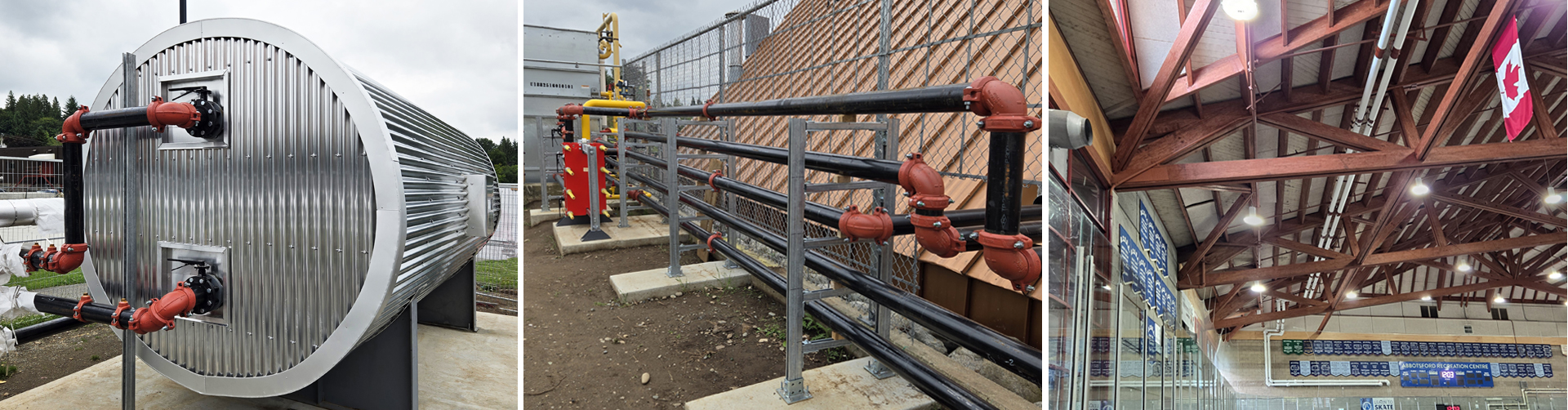
Left to right: Thermal storage tank and the exterior/interior interconnecting piping at the Abbotsford Recreation Centre.
Lesson 3 – Strategic phasing reduces risk and unlocks opportunity
Most existing facilities cannot execute deep decarbonization all at once. Phasing spreads capital, reduces disruption, often aligns with asset renewal cycles, and at times can help improve the business case.
Langara College exemplifies this approach through its multi-year decarbonization roadmap: a deep retrofit of its oldest building, followed by a central heating plant and district energy loop, domestic hot water electrification, and future campus-wide heat recovery integration. This long-term strategy allows the College to sequence investments and maintain service continuity while pursuing a 2030 decarbonization vision.
Quamichan School followed a similar phased roadmap to align upgrades with capital cycles and minimize disruption. Meanwhile, at 2110 W 43rd Avenue, a building that houses small businesses and the Pacific Spirit Community Health Centre, a staged approach enabled incremental electrification and heat recovery while maintaining service and budget discipline.
Lesson 4 – Apply integrated, operator friendly design
Across projects, several themes consistently emerged as critical for long-term performance:
- Keep designs simple, particularly for heat recovery chillers, low temperature hydronic systems, and variable refrigerant flow (VRF) systems, and document clearly and completely to avoid misunderstandings.
- Validate all assumptions through functional testing and commissioning, including actual heating and cooling loads, heat pump sensitivity to supply water temperature, and coil performance.
- Design for constraints, tight mechanical rooms, limited electrical capacity, heritage structures, and required occupancy.
- Prioritize operator usability, clear building automation system graphics, intuitive controls, and accessible components.
The Hillcrest Community Centre retrofit in Vancouver illustrates the value of these principles. Prism resolved long standing heat recovery failures by redesigning piping, installing larger pool heat exchangers, simplifying controls, and integrating heat recovery into domestic hot water production. The result: over $92,000 in annual energy savings and 700 tonnes of CO₂e reduction per year.
Lesson 5 – Commissioning and long-term optimization are non-negotiable
Decarbonization projects interact with existing systems in complex ways. Continuous commissioning and monitoring across seasons are essential to achieving projected performance. Projects such as Hope Recreation Centre, 650 W. Georgia and Kitsilano Community Centre (PDF) reinforced the need for:
- Availability of all parties during commissioning.
- Clear control specifications (not assumptions).
- Sufficient training and documentation for operators.
- Flexibility to respond to unanticipated on-site conditions.
- Commissioning not over one day, but over multiple seasons

Left to right: Piping connecting campus buildings, heat exchange pump, and connecting pipes between buildings during construction at Langara.
What these lessons mean for your organization
Decarbonizing existing buildings can be complex, but it also offers major opportunities: lower operating costs, reduced emissions, renewed systems, and even improved comfort. Prism Engineering’s work across BC shows that success doesn’t depend on a single technology. It comes from the right mix of planning, technical rigour, and engagement of people.
Get the details
Want to dive deeper? Download the slide deck (PDF) presented at the EGBC session to explore project data, visuals, and summaries referenced in this article.
If your organization is exploring how to reduce carbon emissions while renewing aging infrastructure, or you’re just curious to learn more about our approach, our team can help you chart a clear, actionable, and cost-effective path forward.
Let’s TalkPrism is here to support your organization’s success.
Read more about our services
Deep Carbon Retrofits
Recommissioning and Retro-commissioning
See project examples
Our 20+ Years Partnership with Langara College
Vancouver School Board | Recommissioning
Banner image: Engineers and Geoscientists BC Conference and AGM, Photographer Wendy D Photography (image modified by Prism Engineering).